30 Great Myths about Jane Austen by Claudia L. Johnson & Clara Tuite
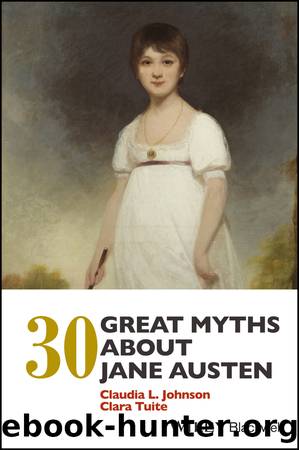
Author:Claudia L. Johnson & Clara Tuite [Johnson, Claudia L. & Tuite, Clara]
Language: eng
Format: epub
ISBN: 9781119146889
Published: 2020-06-25T00:00:00+00:00
Not so long ago, this passage was read as Jane Austenâs credo, an affirmation of the ideology of the Great House. But the free indirect discourse gives us Fannyâs thoughts, not those of Austen or her narrator. To be sure, Fanny thinks of Mansfield Park as a Great Good Place, where everyone and everything is harmoniously and responsibly ordered, where all the contention and conflict that inevitably arise in family life are, if not excluded, at least minimized by fairness and politeness, by benevolent, caring, and effectual authority. In short, Fanny sees Mansfield Park as another Pemberley. But, ever since the first chapter of this novel, we have been shown that this is emphatically not the case. Sir Thomas authorizes Mrs. Norrisâs nastiness; the Bertram sisters fight as intensely over Henry Crawford as Fannyâs Portsmouth sisters fight over a knife; Sir Thomas approves Mariaâs loveless marriage to a rich and wellâconnected dolt; Tom Bertram has depleted Mansfield Parkâs coffers with his gambling debts. Indeed, the âtread of violenceâ and the âsounds of contentionâ â all loud and clear at Portsmouth â are not heard, but thatâs only because no one â least of all Sir Thomas â is listening. There is a class difference between Portsmouth and Mansfield Park, to be sure, and this is nothing to sneeze at, but there is not really a moral difference. And then, of course, there is the issue of Antigua, where Sir Thomas must repair to fill the coffers his son has drained, and of the slavery on which it subsists. If nothing else, Pemberley shows us that Jane Austen knew how to make the great estate look good, and Pride and Prejudice comedically fosters and indulges this effort of idealization. Fannyâs idealization, by contrast, is so wishful as to verge on delusional, as her own presence in Portsmouth proves.
Mansfield Park explores not only failures of authority but also, relatedly, failures of basic lucidity. While Austenâs other novels prize discernment and contrive scenes of enlightenment or selfâunderstanding, in Mansfield Park the language of pathological intellection seems to jump out of every page. Characters are always pronouncing other peopleâs minds as âdiseased,â as âvitiated,â as âdisordered,â or âtainted;â Mansfield is supposed to act as âa cure,â much as Fannyâs exile to Portsmouth is a âmedicinal projectâ upon Fannyâs âunderstandingâ designed to heal her âpowers of comparing and judging.â Indeed, all of the characters in this novel, Fanny not excepted, seem to shut their eyes while they look, or their understandings while they reason, as the narrator says specifically of Julia Bertram. The kinds of figures in whom we are accustomed to repose trust are in this novel all worrisomely benighted. On whom can we rely? Not the dignified paternal figure, who while always making a pompous pose of rectitude is really interested in money and influence. Not the serious young clergyman who, befuddled by his own desires, is seduced by Mary Crawfordâs dodginess and blind to his own inconstancy. Not the lively heroine, who is always calculating and blundering.
Download
This site does not store any files on its server. We only index and link to content provided by other sites. Please contact the content providers to delete copyright contents if any and email us, we'll remove relevant links or contents immediately.
4 3 2 1: A Novel by Paul Auster(12352)
The handmaid's tale by Margaret Atwood(7726)
Giovanni's Room by James Baldwin(7297)
Asking the Right Questions: A Guide to Critical Thinking by M. Neil Browne & Stuart M. Keeley(5734)
Big Magic: Creative Living Beyond Fear by Elizabeth Gilbert(5721)
Ego Is the Enemy by Ryan Holiday(5384)
The Body: A Guide for Occupants by Bill Bryson(5063)
On Writing A Memoir of the Craft by Stephen King(4909)
Ken Follett - World without end by Ken Follett(4701)
Adulting by Kelly Williams Brown(4549)
Bluets by Maggie Nelson(4533)
Eat That Frog! by Brian Tracy(4497)
Guilty Pleasures by Laurell K Hamilton(4417)
The Poetry of Pablo Neruda by Pablo Neruda(4077)
Alive: The Story of the Andes Survivors by Piers Paul Read(4009)
White Noise - A Novel by Don DeLillo(3987)
Fingerprints of the Gods by Graham Hancock(3974)
The Book of Joy by Dalai Lama(3957)
The Bookshop by Penelope Fitzgerald(3826)
